
Best FM Antenna for Home Stereo: 5 Options Compared

Bingfu 75-Ohm FM Dipole suits most home stereo owners because its 10-foot cable and three connector adapters offer flexible indoor placement across common receiver inputs. Choose Ancable 300-Ohm T Dipole instead if your receiver uses 300-ohm clip terminals, or AEDIKO 75-Ohm FM and AM Antenna Set if you also want an AM loop antenna.
An FM antenna receives broadcast signals in the 88–108 MHz band; connector type and placement can matter as much as antenna style.
We earn a commission if you buy through links on this page. As an Amazon Associate I earn from qualifying purchases. Products are compared on manufacturer specifications, not hands-on testing.
- Best overall: Bingfu 75-Ohm FM Dipole – Its 10-foot cable and three adapters cover several common receiver connections.
- Best for magnetic mounting: Magnetic-Base FM Antenna, 16-Foot Cable – A magnetic-base and 16-foot cable allow placement on a metal surface.
- Best for 300-ohm terminals: Ancable 300-Ohm T Dipole – Its spade terminals connect to receivers with clip-style FM sockets.
- Best for AM and FM: AEDIKO 75-Ohm FM and AM Antenna Set – The set pairs a 75-ohm FM coax antenna with an AM loop antenna.
| Product | Best for | Antenna type | Cable length | Connection | Shop |
|---|---|---|---|---|---|
| Bingfu 75-Ohm FM Dipole | Flexible placement | Dipole | 10 ft | F-type with 3 adapters | Check Price on Amazon |
| Magnetic-Base FM Antenna, 16-Foot Cable | Metal-surface mounting | Retractable antenna | 16 ft | 75-ohm coax | Check Price on Amazon |
| Ancable 300-Ohm T Dipole | Clip-terminal receivers | T-shaped dipole | 5.9 ft | 300-ohm spade terminals | Check Price on Amazon |
| AEDIKO 75-Ohm FM and AM Antenna Set | AM/FM listening | FM coax plus AM loop | 4.9 ft | F-type FM; bare-wire AM | Check Price on Amazon |
| Antop Amplified Indoor AM/FM Antenna | Amplified indoor setup | Amplified multidirectional | — | F-female FM; AM spring clip | Check Price on Amazon |
FM Antennas for Home Stereo
Match the antenna connection to the receiver first, then compare cable reach and mounting style.
Bingfu 75-Ohm FM Dipole

The 10-foot cable and three included adapters make this dipole the most flexible fit for receivers with different antenna sockets. It has a 75-ohm unbalanced connection, adhesive wall mounting, and adapters for F-type, TV female, TV male, and 3.5 mm connections. The maker says it improves FM stereo reception. This is a practical choice when the receiver sits away from a window or wall, but the adhesive mount is less suited to buyers who want a freestanding or magnetic-base.
Bottom line: Choose this if you want extra cable reach and multiple connection options.
Magnetic-Base FM Antenna, 16-Foot Cable

The magnetic-base sets this model apart: it can sit on a metal surface while its 16-foot cable gives more placement reach than the shorter wired options here. It uses a 75-ohm coaxial connection and includes a retractable antenna. The maker says it is designed for indoor stereo receivers and radios. Choose it when you have a suitable metal spot and want the antenna positioned away from the receiver; the magnet is not useful on nonmetal surfaces, where an adhesive or freestanding option may fit better.
Bottom line: Pick this when a metal mounting point and long cable suit your room.
Ancable 300-Ohm T Dipole
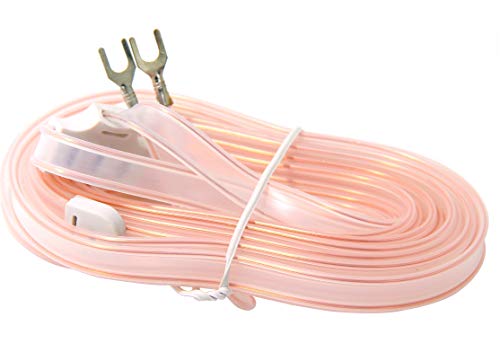
The 300-ohm spade terminals distinguish this T-shaped dipole from the coax-connected antennas in this group. Its 5.9-foot cable is intended for receivers with clip or terminal-style FM sockets, and the maker recommends stretching the antenna ends apart and away from the receiver. That connection makes it a direct match for older tuners with 300-ohm terminals. It is not the right pick for a receiver that only has a 75-ohm F-type coaxial input, so check the receiver’s rear panel before choosing.
Bottom line: Choose this for a receiver with 300-ohm clip-style FM terminals.
AEDIKO 75-Ohm FM and AM Antenna Set

The included AM loop antenna makes this a two-band set rather than an FM-only purchase. The FM antenna has a 4.9-foot cable, 75-ohm impedance, and an F-type male plug; the AM loop uses two bare wires. The maker says the set is designed for indoor receivers and can be used in rooms such as offices, garages, or attics. It suits buyers who want both AM and FM connections covered, but its shorter FM lead offers less placement reach than the 10- and 16-foot choices.
Bottom line: Pick this if you need a matching AM loop as well as FM reception.
Antop Amplified Indoor AM/FM Antenna
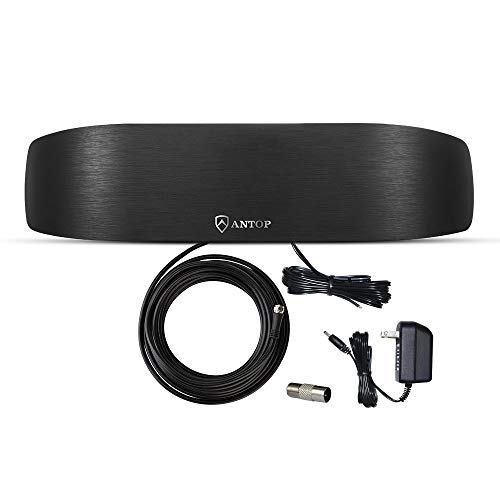
The amplified, multidirectional design separates this antenna from the passive dipoles and coax wires. It is made for AM/FM receivers and includes an FM F-female connection, an AM spring-clip connection, and an IEC male-to-F female adapter. The maker claims a 50-mile range and includes an amplifier and 4G filter. This option suits a buyer seeking an amplified indoor design, but the features do not give a cable length; confirm the reach and power requirements before choosing a mounting spot.
Bottom line: Choose this if you specifically want an amplified multidirectional AM/FM antenna.
How to Choose an FM Antenna for Home Stereo
Start by matching the receiver’s antenna socket: 75-ohm coaxial inputs take coax antennas, while 300-ohm terminals use twin-lead or spade-terminal connections. FM broadcasts occupy 88–108 MHz, so an FM antenna is tuned for that band rather than the VHF television bands. Cable reach and mounting style then determine how easily you can move the antenna away from the receiver. If your stereo has only one antenna jack, read the socket label or manual before buying an adapter; a connector that physically fits does not always match the receiver’s impedance. For weak reception, try a different position before assuming a powered antenna is necessary.
75-Ohm Coax and 300-Ohm Terminals
Choose 75-ohm coax for an F-type or coaxial FM input, and choose a 300-ohm dipole for two screw or clip terminals. These are different connection systems: a coax lead has a central conductor and shield, while 300-ohm twin-lead uses two conductors. A matching transformer, often called a balun, can adapt between 300-ohm twin-lead and 75-ohm coax when the receiver connection requires it. Use the receiver’s labeled FM input rather than assuming an AM terminal is interchangeable. The table maps the connection style to the practical choice.
| Receiver connection | Antenna style | Selection rule |
|---|---|---|
| 75-ohm coax or F-type | Coax antenna | Choose a matching 75-ohm lead |
| Two FM clips or terminals | 300-ohm dipole | Choose spade or twin-lead terminals |
Where to Place an Indoor FM Antenna
Place an indoor antenna as high and unobstructed as practical; a window or exterior-facing wall is often a useful starting point. FM signals are line-of-sight at typical listening distances, and hills, dense buildings, and metal structures can weaken or reflect them. Move the antenna several feet at a time and rescan or tune the station after each move, since multipath reflections can make one spot sound worse than another. Keep the antenna away from large metal surfaces and electronic equipment when possible. With less than 6 feet of usable cable between the receiver and a better window-side location, prefer a model with a longer lead or plan an appropriate extension.
When an Amplified FM Antenna Makes Sense
An amplifier can raise a weak signal, but it cannot restore a station blocked by terrain or severe multipath, and excess amplification can overload a receiver near strong local stations. Try repositioning a passive antenna first, especially if several stations fade or distort together. A directional antenna can help when distant stations come from one direction, while a multidirectional design avoids frequent turning. Indoor antennas trade simpler installation for limited height and placement compared with an outdoor antenna. Do not mount an antenna where it can contact overhead power lines; keep outdoor installations clear of electrical conductors and secure them against wind.
Frequently Asked Questions
What FM frequency range should a home antenna cover?
FM broadcast radio in the United States spans 88–108 MHz. An antenna intended for FM reception is designed to work in that band.
How far apart should FM dipole ends be?
Spread the dipole arms as far apart as their design allows; a half-wave dipole for the FM band is roughly 5 feet end to end. Keep the arms away from large metal objects and try a horizontal or vertical orientation if reception is weak.
Can I connect a 300-ohm antenna to a 75-ohm receiver?
Yes, a 300-to-75-ohm matching transformer can bridge the two connection types. Confirm that the receiver has a 75-ohm FM input and use the matching connection rather than forcing incompatible terminals together.
Does an indoor FM antenna need to face a station?
A simple dipole is not highly directional, but its orientation and position can change reception because reflected FM signals arrive from different paths. Rotate or reposition it in small steps and retune after each change.
Will an FM antenna also receive AM stations?
An FM-only antenna is not a substitute for an AM antenna, because AM radio uses much lower frequencies. A set with a separate AM loop or AM lead is the straightforward choice when both bands are needed.