
Dynamic Friction 5000 Brake Pads: Fit and Features

For a front-only Dynamic Friction 5000 Advanced pad set, DFC 5000 Advanced Front Pads is the closest match because it includes four front pads and hardware. Choose DFC 5000 Advanced Rear Pads for a rear set, or DFC 5000 Advanced Maserati Rear Pads if its vehicle and caliper application matches yours.
Brake pads create friction against the rotor to slow the wheel; matching axle position and vehicle fit matters more than choosing by series name alone.
We earn a commission if you buy through links on this page. As an Amazon Associate I earn from qualifying purchases. Products are compared on manufacturer specifications, not hands-on testing.
- Best overall: DFC 5000 Advanced Front Pads – Includes four front 5000 Advanced pads and hardware.
- Best for rear axle: DFC 5000 Advanced Rear Pads – A rear-set of four 5000 Advanced pads.
- Best for listed Maserati fit: DFC 5000 Advanced Maserati Rear Pads – Identifies rear 5000 Advanced pads for named Maserati applications and includes hardware.
| Product | Best for | Axle/application | Included components | Shop |
|---|---|---|---|---|
| DFC 5000 Advanced Front Pads | Front pad replacement | Front | Hardware | Check Price on Amazon |
| DFC 5000 Advanced Rear Pads | Rear pad replacement | Rear | Pads only | Check Price on Amazon |
| DFC 5000 Advanced Maserati Rear Pads | Listed Maserati applications | Rear; listed Maserati models | Hardware | Check Price on Amazon |
Dynamic Friction 5000 Brake Pads Compared
Compare axle position, vehicle application and included parts before choosing a pad set.
DFC 5000 Advanced Front Pads

For a front-axle pad-only replacement, this set includes four Dynamic Friction 5000 Advanced pads and hardware. The manufacturer describes the formula as OEM-grade and says it is compatible with ABS, with low dust and rotor-friendly wear. The package also carries a one-year warranty for manufacturer defects. This is the most direct match for a buyer looking specifically for front 5000 Advanced pads, rather than a complete rotor kit.
Bottom line: Choose this set when you need front 5000 Advanced pads and have confirmed vehicle fit.
DFC 5000 Advanced Rear Pads
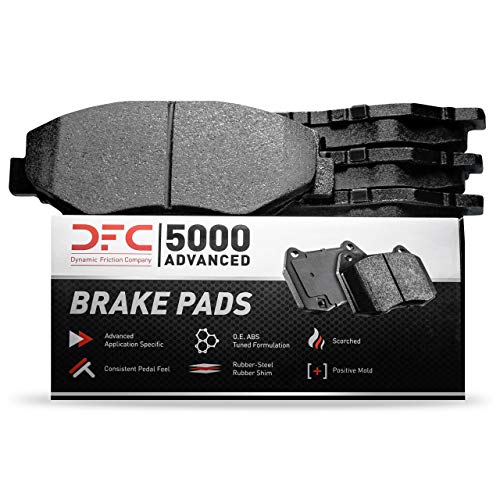
Unlike the front set, this package is designated for rear brake replacement and contains four 5000 Advanced pads. The manufacturer says the pads provide consistent pedal feel, ABS compatibility and low dust, and includes a one-year warranty against manufacturer defects. It is a pad-only option for buyers whose rear pads need replacement while the rotors remain suitable for continued use. The package does not identify a vehicle application, so confirm the rear axle fit for your specific vehicle; front and rear pads are not interchangeable simply because they share a product family.
Bottom line: Choose this set for a confirmed rear-axle application that needs pads, not rotors.
DFC 5000 Advanced Maserati Rear Pads

This vehicle-targeted set differs from the general rear set by naming Maserati Ghibli, Levante and Grecale applications and including hardware with its four rear 5000 Advanced pads. The application text specifies Ghibli 4-piston front calipers, Levante model years 2017–2024, and Grecale GT and Modena model years 2023–2024; confirm the exact vehicle configuration before selection. The manufacturer describes the pads as low-dust with consistent pedal feel and rotor-friendly wear. The limitation is narrow vehicle coverage, so this is not a general-purpose rear pad choice.
Bottom line: Choose it only when your Maserati and caliper configuration match the application.
How to choose 5000 brake pads
Choose by axle, vehicle fit and pad compound before comparing accessory kits. Front and rear pads have different shapes and are not interchangeable; verify the vehicle year, make, model, trim and caliper configuration against a fitment reference. Ceramic and semi-metallic are different friction-material categories, but the 5000 name alone does not establish which compound suits every vehicle or driving need. Replace pads in axle pairs so braking remains balanced side to side. If the vehicle pulls, vibrates or makes grinding sounds, do not assume pads alone are the cause: rotors, calipers and suspension can also affect braking. Confirm whether the job calls for pads alone or a rotor-and-pad replacement before selecting parts.
When to replace brake pads
Many passenger vehicles use a minimum pad thickness near 2 to 3 millimeters as a replacement threshold, but the vehicle maker’s service limit takes priority. Pad wear can differ between inner and outer pads, and front pads often wear faster because braking transfers load forward. A wear indicator may squeal before the friction material reaches its limit; grinding can signal metal-to-metal contact and requires prompt inspection. Ask for remaining pad thickness measured in millimeters rather than relying only on a visual estimate through a wheel. If a brake warning light, fluid leak or soft pedal appears, treat it as a safety issue and have the braking system inspected before driving normally.
What to know about bedding new pads
New pads and rotors need a controlled bedding process to establish an even friction layer, and the exact procedure depends on the pad maker and vehicle. A common street-pad process uses several moderate stops from about 30 to 40 mph, with cooling time between stops; avoid repeated hard stops or holding the brake pedal down while components are very hot. Bedding is not a substitute for correct installation, clean mating surfaces or proper wheel fastener torque. Follow the procedure when available, and allow extra stopping distance while new components settle. If the pedal feels soft, the vehicle pulls, or braking noise persists after installation, stop and have the work checked.
Brake pad replacement mistakes to avoid
The most common fit mistake is matching only the model name while overlooking axle, trim or caliper differences. Confirm the front-versus-rear position and the exact vehicle configuration before opening the package. Another error is installing new pads against rotors with deep grooves, heat cracks or thickness below the vehicle’s minimum; rotors need inspection and measurement during a pad service. Replace pads as a left-right axle pair, and use the correct hardware rather than reusing damaged clips. Brake dust can contain irritating particles, so avoid blowing it into the air with compressed air; use a suitable brake-cleaning method and protective equipment. Any hydraulic line opening requires proper bleeding before driving.
Frequently Asked Questions
How many millimeters of brake pad remain before replacement?
Many passenger vehicles call for replacement around 2 to 3 millimeters of friction material, but the vehicle’s service limit is the deciding value. Have inner and outer pads checked because they can wear unevenly.
Do front and rear brake pads use the same shape?
Usually not; axle-specific pads have different dimensions and hardware, even on the same vehicle. Match the part to the vehicle’s front or rear position and exact configuration.
Should brake rotors be replaced with new pads?
Not automatically; rotors can remain in service if they are above minimum thickness and free of harmful damage. Deep grooves, cracks or thickness below the vehicle limit are reasons to replace or service them.
How should new brake pads be bedded in?
Use the procedure specified for the pad and vehicle; many street-pad processes use a series of moderate stops from roughly 30 to 40 mph with cooling intervals. Avoid repeated hard stops and prolonged pedal pressure while the brakes are hot.
Can I drive with a grinding brake noise?
Grinding can mean the friction material is worn through and metal is contacting the rotor. Avoid normal driving and arrange prompt brake inspection, especially if stopping distance or pedal feel has changed.