
HyperX Cloud 1 Headset: Models Compared by Fit

The HyperX Cloud Alpha is the closest match for a HyperX Cloud 1 headset because it keeps the wired 3.5 mm design and broad platform compatibility. Choose another option if you need an Xbox-licensed model, a newer USB connection, or a different platform mix.
We earn a commission if you buy through links on this page. As an Amazon Associate I earn from qualifying purchases. Products are compared on manufacturer specifications, not hands-on testing.
- Best overall: HyperX Cloud Alpha Wired – Its wired 3.5 mm connection supports PC, consoles, Switch, and mobile devices with a compatible port.
- Best for Xbox: HyperX CloudX Xbox – It is officially licensed for Xbox and works with controllers that have a 3.5 mm headset jack.
- Best for USB options: HyperX Cloud III Wired – It includes USB-C, USB-A, and 3.5 mm connectivity.
| Product | Best for | Connection | Platform fit | Microphone | Shop |
|---|---|---|---|---|---|
| HyperX Cloud Alpha Wired | Multi-platform use | 3.5 mm | PC, PS4/5, Xbox, Switch, mobile | Detachable noise-cancelling | Check Price on Amazon |
| HyperX Cloud II Wired | Virtual surround | Wired | PC, PS4, Xbox One | Detachable microphone | Check Price on Amazon |
| HyperX CloudX Xbox | Xbox controllers | Wired, 3.5 mm | Xbox One, Series X|S | Detachable noise-cancelling | Check Price on Amazon |
| HyperX Cloud III Wired | USB flexibility | USB-C, USB-A, 3.5 mm | PC, PS5, Xbox Series X|S | Noise-cancelling, mute indicator | Check Price on Amazon |
| HyperX Cloud Stinger 3 | PC and PlayStation | Wired | PC, Nintendo Switch, PS5 | Adjustable noise-cancelling | Check Price on Amazon |
HyperX Cloud 1 headset alternatives
Compare these related wired headsets by connection, platform support, and the features that set each apart.
HyperX Cloud Alpha Wired

For a wired headset closest to the broad platform reach associated with the Cloud line, the Cloud Alpha connects through a 3.5 mm port and is listed for PC, PlayStation, Xbox, Nintendo Switch, and mobile. Its dual-chamber drivers are designed to separate sound and reduce distortion, while a detachable braided cable has in-line audio control.
The aluminum frame and expanded headband suit someone who wants a sturdier-feeling design; the cable connection is the limitation for devices without a compatible 3.5 mm port. Its detachable noise-cancellation microphone is useful if you sometimes use the headset without a mic attached.
Bottom line: Choose it for a wired 3.5 mm headset that spans several platforms.
HyperX Cloud II Wired

The Cloud II is the option here with hardware-driven 7.1 virtual surround sound, alongside 53 mm drivers and memory foam ear cushions. Its over-ear fit and padded leatherette headband are aimed at comfort during gaming sessions, and it is described for PC and older PlayStation and Xbox platforms.
Choose it if virtual surround is a priority and your setup matches its supported platforms. It is wired, so a wireless setup is not a fit.
Bottom line: Pick it when hardware-driven virtual surround matters most.
HyperX CloudX Xbox
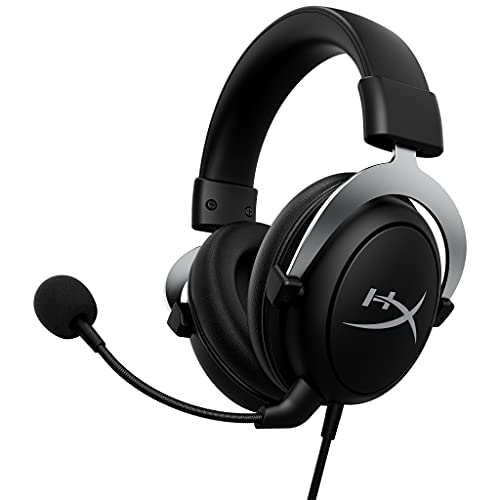
The CloudX is the clearly Xbox-focused choice: it is officially licensed and tested by Microsoft, and works with Xbox controllers that have a 3.5 mm headset jack. In-line controls let you adjust volume and mute the mic without navigating console settings. Its memory foam cushions and aluminum frame distinguish it from a more basic wired setup.
This narrow platform focus is an advantage for Xbox owners but a limitation for people seeking broad device coverage. The compatibility named here centers on Xbox One and Series X|S, so users on other platforms should verify support before choosing it.
Bottom line: Choose it for Xbox use with a controller’s 3.5 mm jack.
HyperX Cloud III Wired

The Cloud III adds three connection types—USB-C, USB-A, and 3.5 mm—so it offers more connection choices than the other wired options here. Its angled 53 mm drivers are tuned for gaming, while the noise-cancelling microphone has a mesh filter and an LED mute indicator. Memory foam cushions and headband padding provide the familiar over-ear comfort approach.
It suits a setup that can use one of its connections and platform support. Compared with the Cloud Alpha, the platform list names newer PlayStation and Xbox generations but not Switch or mobile, so it is less clearly aimed at those devices.
Bottom line: Pick it for multiple wired connection options and a mute indicator.
HyperX Cloud Stinger 3

The Cloud Stinger 3 is the simpler wired option for PC, Nintendo Switch, and PlayStation 5, with 50 mm drivers and spatial audio through NGENUITY software on PC. Its adjustable noise-cancelling microphone and metal sliders are distinct features, while breathable leatherette and memory foam make up the earcups.
It makes sense for someone who wants the named PC and PlayStation support with spatial audio software on PC.
Bottom line: Choose it for PC or PS5 with spatial audio software on PC.
How to choose a HyperX Cloud 1 headset alternative
Choose first by connection and platform, then by comfort features. A 3.5 mm headset plugs into a compatible headset jack; USB headsets use a USB port, and the port type must match the device or adapter. For the widest platform mix among these options, the Cloud Alpha names PC, PlayStation, Xbox, Switch, and mobile. The CloudX is explicitly Xbox-licensed, while the Cloud III lists USB-C, USB-A, and 3.5 mm.
For console controllers, check whether the controller has a headset jack: the CloudX specifies a 3.5 mm jack. If you want detachable hardware, distinguish the detachable microphone and cable on the Cloud Alpha from in-line controls on other models. Wired models do not remove cable constraints, so cable routing and port access matter.
Wired headset connections and console fit
A 3.5 mm connection is the deciding fit condition when using a headset directly with a controller; choose a model explicitly compatible with your console generation. The Cloud Alpha names both PS4/PS5 and Xbox One/Series X|S, while Cloud II specifies older PlayStation and Xbox One systems. The Cloud III names PS5 and Xbox Series X|S, and the CloudX names Xbox One and Series X|S.
USB-C and USB-A broaden connection choices, but the port must still be supported by the device; Cloud III includes both along with 3.5 mm. For wired audio, a port shape alone does not guarantee platform support, so check that your specific console or controller accepts the chosen connection before ordering.
What headset features change the experience
Virtual surround, driver design, and microphone controls are different feature choices, not interchangeable measures of sound quality. The Cloud II features hardware-driven 7.1 virtual surround; the Cloud Alpha uses dual-chamber drivers intended to distinguish audio and reduce distortion. The Cloud III has angled 53 mm drivers and a microphone mute indicator, while the Stinger 3 supports spatial audio through NGENUITY software on PC.
For long sessions, memory foam ear cushions and padded headbands can affect comfort, but fit depends on head shape and adjustment. A detachable microphone can be removed when unused, while an adjustable microphone changes position and an in-line control keeps volume or mute functions on the cable. Choose controls by how you expect to adjust audio during play.
Common compatibility mistakes with gaming headsets
The most common mistake is assuming every headset works with every console because it uses a familiar plug. Platform support differs: an Xbox-licensed model is specifically described for compatible Xbox controllers, while the Cloud Alpha lists a wider spread of platforms. A USB connector also does not establish console support by itself.
Before choosing, match the model’s platform list to the exact console and connection you plan to use. For Xbox controller audio, confirm a 3.5 mm headset jack when selecting CloudX. For PC-only software features such as NGENUITY spatial audio, make sure the headset will be used with a PC. This prevents buying around a feature that is not available in the intended setup.
Frequently Asked Questions
Does a wired gaming headset need a controller jack?
A 3.5 mm wired headset needs a compatible 3.5 mm input for direct controller connection. The CloudX specifically requires an Xbox controller with that jack; otherwise, check the device’s supported connection path.
What is the difference between USB-C and 3.5 mm headsets?
USB-C is a digital USB connection, while 3.5 mm carries analog headset audio through a headphone jack. The Cloud III includes USB-C, USB-A, and 3.5 mm, so select the one your device supports.
Is virtual surround the same as spatial audio?
No: these are different implementations and should not be assumed equivalent. Cloud II specifies hardware-driven 7.1 virtual surround, while Stinger 3 specifies spatial audio through NGENUITY software on PC.
Can a detachable microphone be removed for storage?
A detachable microphone is designed to separate from the headset, as on the Cloud Alpha. Store the mic safely and avoid pulling on the connector; an adjustable microphone, such as the Stinger 3’s, changes position but is not described as detachable.
Which headset features help with longer gaming sessions?
Memory foam ear cushions and padded headbands are comfort features used on several options here. Fit still depends on the wearer, so adjust the headband and cushions rather than assuming one design fits every head.