
Temperature Controlled Soldering Irons Compared by Type

For most bench work, YIHUA 926 III 60W Station Kit is the strongest fit because its station offers PID temperature stabilization, calibration support and an integrated holder. Choose 80W LCD Soldering Iron Pen Kit instead if you want a standalone pen with an LCD and a 180°C–480°C adjustment range; choose a station or a specific kit based on your workspace and accessories.
We earn a commission if you buy through links on this page. As an Amazon Associate I earn from qualifying purchases. Products are compared on manufacturer specifications, not hands-on testing.
- Best overall: YIHUA 926 III 60W Station Kit – PID temperature stabilization, calibration support and two helping hands suit bench soldering.
- Best for a compact station: WEP 926LED V3 130W Station Kit – The iron holder is integrated into the station body to save desk space.
- Best for a standalone pen: 80W LCD Soldering Iron Pen Kit – An LCD and a 180°C–480°C adjustment range distinguish the pen-style setup.
| Product | Best for | Power | Temperature range | Stand or holder | Shop |
|---|---|---|---|---|---|
| YIHUA 926 III 60W Station Kit | Stable bench work | 60 W | 194°F–896°F | Integrated holder | Check Price on Amazon |
| WEP 926LED V3 130W Station Kit | Small workspaces | 130 W max | 392°F and up | Integrated holder | Check Price on Amazon |
| 80W LCD Soldering Iron Pen Kit | Portable pen setup | 80 W | 356°F–896°F | Separate stand | Check Price on Amazon |
| 60W Adjustable Soldering Iron Kit | Simple adjustable pen | 60 W | 392°F–842°F | — | Check Price on Amazon |
Temperature Controlled Soldering Irons
Compare a standalone pen with station-based setups by control features, workspace needs and included accessories.
YIHUA 926 III 60W Station Kit
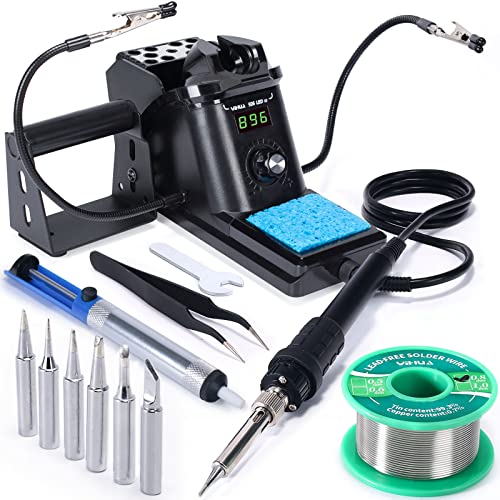
For bench work where temperature stability matters, this station is the only option here that specifies PID stabilization and calibration support. Its 60W iron has a digital display and supports Celsius/Fahrenheit conversion; the kit also includes two helping hands, six extra tips, lead-free solder, a solder sucker and tweezers. The station’s integrated holder and rear protective mesh keep the setup compact. The maker says it conforms to the UL Standard for U.S. electrical appliances. Its 60W rating is lower than the 80W pen and 130W-max station, so it may be less suited to work that benefits from higher available power.
Bottom line: Pick this for a compact bench setup with stabilization and calibration features.
WEP 926LED V3 130W Station Kit

For limited desk space, this station integrates the iron holder into its body, unlike a standalone pen. The kit includes solder wire, five extra tips, tweezers and a desoldering pump. It offers temperature control, sleep mode and Celsius/Fahrenheit conversion, with a maximum power rating of 130W. The included tip cleaner helps with routine tip maintenance. The available temperature-range text gives a 392°F lower endpoint but no upper endpoint, so confirm the full adjustment range before choosing it for a particular soldering task. Its station format and accessory set make it a useful choice for hobby benches that need desoldering tools too.
Bottom line: Choose this when a built-in holder and desoldering accessories matter most.
80W LCD Soldering Iron Pen Kit

Unlike the station kits, this 80W model is a standalone iron pen with an LCD that displays the temperature. The maker says it heats in 20 seconds and offers adjustment from 356°F to 896°F. Five tips, a stand, solder wire, sponge and paste come in the kit, so it has basic bench supplies without a control station. Vent holes near the tip and a heat-resistant handle are included in its design. This option lacks the station features of the other picks, such as PID stabilization or sleep mode, so buyers seeking those controls should choose a station instead.
Bottom line: Pick this for a portable pen with a clear digital temperature readout.
60W Adjustable Soldering Iron Kit

For a straightforward adjustable pen, this 60W iron offers a 392°F–842°F range and an on/off switch on the tool. The 12-in-1 kit includes solder wire, a pump, paste and a soldering tip, and the maker says six air vents help limit overheating. Its temperature span is narrower than the 80W pen’s, and the kit is not described as a station with an integrated holder. That makes it a better match for occasional repair tasks than for buyers who want PID stabilization, calibration support or a sleep mode at the bench.
Bottom line: Choose this for an adjustable pen kit with an on/off switch and basic supplies.
How to choose a temperature controlled soldering iron
Choose a station when you want a fixed bench setup and extras such as a holder, sleep mode or calibration; choose a pen when portability and a simple grip matter more. Temperature control sets a target, but tip shape, tip condition and heat transfer also affect the joint. A common starting range for leaded electronics solder is about 600°F–700°F; lead-free work often needs roughly 650°F–750°F, depending on the solder and joint size. Use the lowest temperature that forms a clean joint promptly rather than compensating for a worn or oxidized tip with excessive heat. With frequent bench use or a need for repeatable settings, prioritize stabilization and calibration features over a larger accessory count.
Temperature range and soldering tip fit
Most electronics joints can be handled within roughly 600°F–750°F, while large connectors and ground planes may need more heat transfer rather than simply a much higher setpoint. Match the tip to the joint: a small chisel or conical tip suits fine leads, while a wider chisel transfers heat more effectively to larger pads and wires. A useful decision rule is to choose a broader tip if a joint does not flow within a few seconds at a suitable working temperature; raising temperature alone can damage pads and components. Tip compatibility is not universal across iron families, so check the exact tip series before buying replacement tips. Keep the tip tinned during use and clean it with a damp sponge or brass wool.
Station or standalone soldering iron
Stations keep the control unit, holder and iron together at the bench, while standalone pens use fewer components and are easier to move between work areas. Sleep mode can reduce idle heating when pauses are frequent, but it does not replace turning off and unplugging equipment when finished. PID control measures temperature and adjusts heater power to maintain the selected setting; calibration support helps correct a mismatch between the display and tip temperature. Use this comparison to match the format to the way you work.
| Need | Best format | Reason |
|---|---|---|
| Compact fixed bench | Station | Holder and controls stay in one setup |
| Movement between tasks | Standalone pen | Less equipment to carry |
| Repeatable heat setting | Station with stabilization | Temperature control adjusts heater output |
Soldering iron safety and care
Soldering tips commonly operate above 600°F, hot enough to cause serious burns and ignite nearby materials. Keep the iron in its holder whenever it is not touching a joint, work on a stable nonflammable surface, and keep cords clear of the hot tip. Solder fumes come mainly from flux; use local exhaust ventilation or a fume extractor, and do not lean over the work. Wash hands after handling solder, especially leaded solder, and keep food and drink away from the bench. For tip care, wipe away residue and apply fresh solder to the tip before storage; avoid filing or abrasive sanding because many tips have a plated working surface that can be damaged.
Frequently Asked Questions
What temperature should I use for electronics soldering?
For many small electronics joints, start around 600°F–700°F with leaded solder and about 650°F–750°F with lead-free solder. A larger joint may need a broader tip or more dwell control rather than a much higher setpoint.
How often should soldering iron tips be replaced?
Replace a tip when its working surface is pitted, badly eroded or no longer wets with solder after cleaning. Frequent use and aggressive cleaning shorten tip life, so tin the tip between tasks and avoid abrasion.
Is a soldering station safer than a soldering pen?
A station can provide a dedicated holder and sometimes sleep mode, but either type can cause burns because tips commonly exceed 600°F. Place every hot iron in its holder and use ventilation for flux fumes.
Do soldering iron tips fit every soldering iron?
No, tip shape and fit are specific to iron families, so verify the exact series before ordering replacement tips. Chisel tips generally transfer more heat to broad joints than fine conical tips.
What does PID temperature control do in a soldering station?
PID control adjusts heater output to keep the iron near its selected temperature as heat is drawn into a joint. Tip condition, tip size and calibration still affect the actual temperature at the work.