
Night Driving Glasses for Seniors: 4 Options Compared

For seniors who want glasses that fit-over prescription frames, Anti-Glare Headlight Glasses is the clearest match because its maker describes an over-glasses design and gives a weight of 32 g. Choose another option if you prefer a wrap-around frame or want a different tint.
Night driving glasses use tinted lenses and coatings intended to reduce perceived glare, but they do not restore vision or guarantee safer driving.
We earn a commission if you buy through links on this page. As an Amazon Associate I earn from qualifying purchases. Products are compared on manufacturer specifications, not hands-on testing.
- Best overall: Anti-Glare Headlight Glasses – The maker describes a fit-over design, and the glasses weigh 32 g.
- Best for wrap-around fit: KALIYADI Fit-Over Night-Vision Glasses – The medium wrap-around frame is designed to fit-over prescription glasses.
- Best for yellow polarized lenses: Chiccool Polarized Fit-Over Glasses – The medium fit-over design has yellow polarized lenses.
- Best for one-size fit: Success Eyewear Night Driving Glasses – The yellow-lens option comes in one size and is described as fit-over.
| Product | Best for | Lens tint | Fit | Shop |
|---|---|---|---|---|
| Anti-Glare Headlight Glasses | Prescription wearers | Orange side lenses | Over prescription glasses | Check Price on Amazon |
| KALIYADI Fit-Over Night-Vision Glasses | Wrap-around fit | Yellow lenses | Medium, wrap-around | Check Price on Amazon |
| Chiccool Polarized Fit-Over Glasses | Polarized lens preference | Yellow polarized | Medium, fit-over | Check Price on Amazon |
| Success Eyewear Night Driving Glasses | One-size fit | Yellow tint | One size, fit-over | Check Price on Amazon |
Night Driving Glasses for Seniors
Compare the lens tint and frame fit, then consider whether each design works with your usual eyewear.
Anti-Glare Headlight Glasses

Unlike the yellow-lens options, Anti-Glare Headlight Glasses has orange side lenses and a matte black frame. The maker says its GlareCut technology reduces LED and high-beam glare, and the glasses include an anti-reflective coating, UV protection and a carry case. At 32 g, they are designed to fit-over prescription glasses. The maker also describes the frame as scratch-resistant. The limitation is that the fit measurement is 501-45-46 mm rather than a clear fit range, so the frame may not suit every prescription pair.
Bottom line: Choose these if you need an over-prescription design and prefer orange side lenses.
KALIYADI Fit-Over Night-Vision Glasses

KALIYADI Fit-Over Night-Vision Glasses stands out for its medium, rectangular wrap-around frame, which is described as slightly larger than normal glasses and made to fit-over eyewear. The maker says the yellow lenses and special anti-reflection coating reduce strong light and improve contrast in low-light conditions. That makes the design relevant if you want a wrap-around shape rather than a standard frame.
Bottom line: Pick these if a medium wrap-around fit-over frame is your priority.
Chiccool Polarized Fit-Over Glasses

Chiccool Polarized Fit-Over Glasses is the only option here whose features explicitly call the yellow lenses polarized and UV400. Its medium fit-over frame is also described as lightweight, although the weight value of 0.15 has no unit and should not be compared with the 32 g figure for Anti-Glare Headlight Glasses. The maker says the lenses cut headlight and wet-road glare while keeping the view ahead bright. The limitation is that tint and polarization preferences are personal, and a yellow lens is not a substitute for clear vision or careful night driving.
Bottom line: Choose these if you specifically want yellow polarized lenses in a medium fit-over style.
Success Eyewear Night Driving Glasses
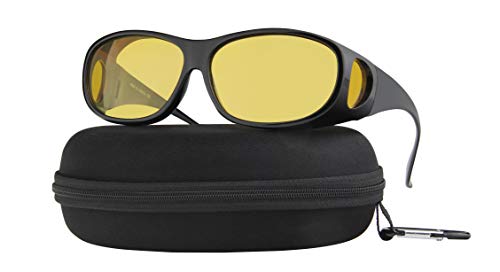
Unlike the medium-sized alternatives, Success Eyewear Night Driving Glasses is offered in one size and is described as fit-over. The maker says its yellow polarized lenses help reduce glare from headlights, street lights and other bright sources. That straightforward size format may appeal if you do not want to choose among several frame sizes. The limitation is that one size does not tell you how the frame will sit over your own glasses; confirm compatibility if your prescription frames are large or have thick temples.
Bottom line: Pick these if you want a one-size, yellow-lens fit-over option.
How to choose night driving glasses for seniors
Start with whether the frame fits over your prescription glasses, then consider tint and lens coating. These options use orange or yellow lenses, and three of the four are explicitly described as fit-over designs. Tinted lenses reduce the amount of visible light reaching the eye; at night, less light can make dim objects harder to see. No tint can make an unsafe level of glare harmless or correct a vision problem.
Use the glasses that meet your actual fit need, not a claim about contrast alone. If your current prescription lenses already have an anti-reflective coating, compare whether an extra fit-over pair adds a practical benefit. A clear, unobstructed view matters more than a colored lens.
Fit-over glasses and prescription frames
Fit-over frames must clear the width, height and temple arms of the glasses underneath. A label such as “Medium” does not provide those measurements, while a size string such as 501-45-46 mm is not a complete compatibility range by itself. If your prescription frames have wide temples or a tall lens shape, confirm the actual inside dimensions before buying.
A useful rule is to measure the widest point of your prescription frame and compare it with the fit-over frame’s interior width; do the same for lens height. Avoid forcing a fit-over pair onto the prescription frame, since pressure can make both pairs sit poorly. Check that the added frame does not obstruct your peripheral view when seated in your normal driving position.
Yellow and orange lenses at night
Yellow and orange tints can change how bright headlights and road markings appear, but any tint also reduces some incoming light. That tradeoff matters most on unlit roads, where there is less ambient light to begin with. A claim that a lens improves contrast does not mean every driver will see more detail or react sooner.
Polarization can reduce reflected glare from surfaces such as wet pavement, but it cannot remove the direct glare of every oncoming headlight. The decision rule is simple: if a tint makes road edges, pedestrians or signs harder for you to see, do not use it for night driving. Never treat yellow lenses as a night-vision aid that compensates for dim vision.
Reduce headlight glare without relying on tint
Clean the inside and outside of the windshield regularly; film and smears scatter light from oncoming vehicles. Keep exterior mirrors and headlamp covers clean, and use the vehicle’s low beams when following or approaching traffic. A dirty windshield can worsen glare even when wearing glasses advertised for night driving.
Keep the dashboard illumination low enough to avoid bright reflections in the glass while still being able to read controls. If glare has recently become more troublesome, arrange a vision check rather than assuming glasses will solve it. Cataracts and other vision changes can contribute to glare sensitivity, and tinted glasses do not address their cause.
Frequently Asked Questions
Do yellow glasses improve night driving vision?
Yellow lenses change the light entering the eye, but they also reduce some light overall. If road markings or pedestrians look dimmer, do not use the tinted glasses at night.
Can fit-over glasses go over prescription glasses?
Fit-over frames are intended to sit over prescription eyewear, but the fit depends on the underlying frame’s width, height and temple shape. Measure those dimensions and compare them with the interior clearance before ordering.
Do polarized lenses stop oncoming headlight glare?
Polarization can reduce reflected glare, such as reflections from wet pavement, but it does not eliminate direct headlight glare. A driver still needs a clear view of the road and should slow down if visibility is poor.
What should seniors do about worsening glare at night?
Schedule an eye examination if night glare is worsening or newly interfering with driving. Headlight glare can be aggravated by a dirty windshield, but tinted glasses do not diagnose or correct vision changes.
Are night driving glasses safe on unlit roads?
Tinted lenses reduce some incoming light, which can matter more on roads without street lighting. Do not wear them if they make dim road edges, signs or people harder to see.